Bulletproof Your Ankles: 4 Pillars to Prevent Sports Injuries
Stop the Sprain: How to Guard Your Ankles in High-Intensity Sports
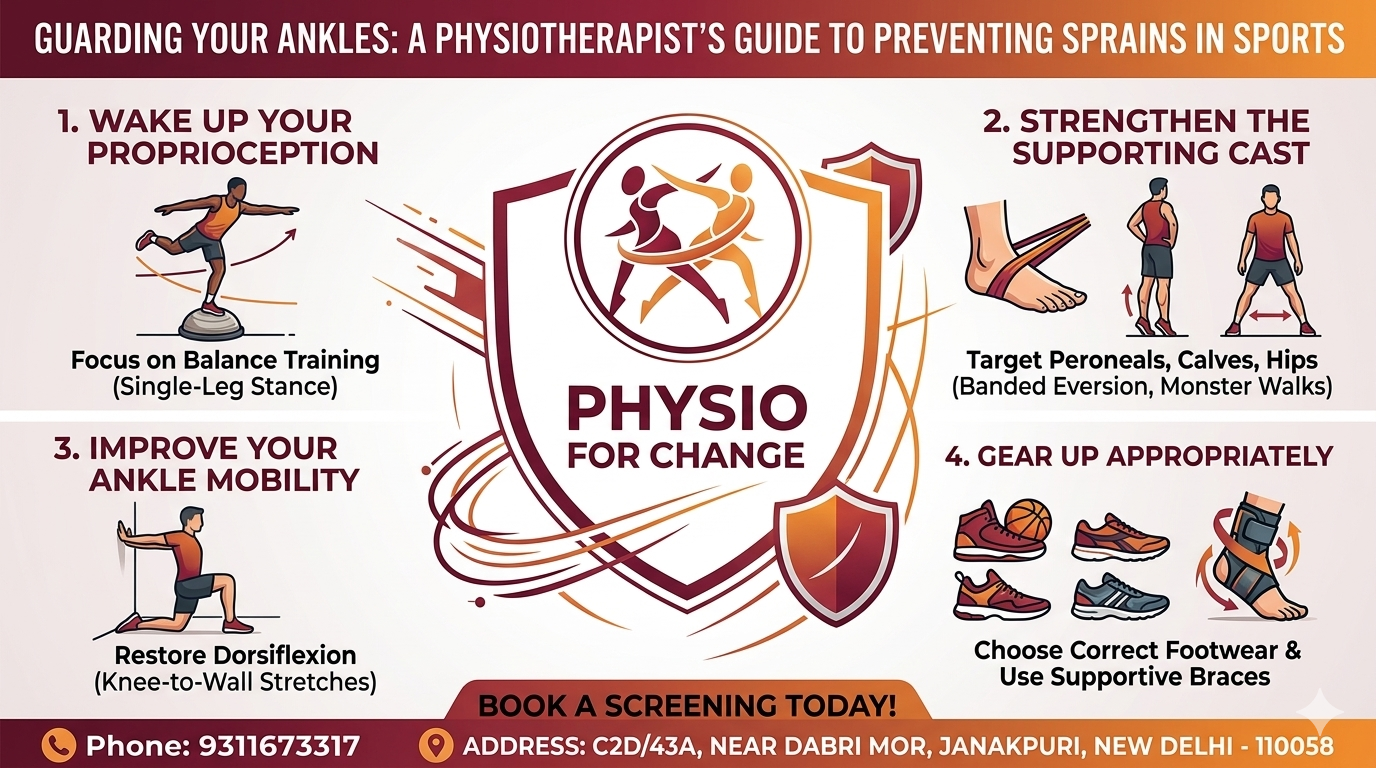
Guarding Your Ankles: A Physiotherapist’s Guide to Preventing Sprains in Sports
We’ve all seen it happen—or worse, felt it happen. You’re cutting across the field, driving to the basket, or navigating a trail, and suddenly, your ankle rolls. The sharp pain kicks in, followed by the dreaded swelling, and just like that, you’re on the sidelines.
Ankle sprains are among the most common sports injuries, but here is the good news: they are largely preventable.
At PHYSIO FOR CHANGE, we believe in proactive movement. You shouldn’t have to wait for an injury to start caring for your joints. Let’s dive into the anatomy of a sprain and the exact, evidence-based steps you can take to keep your ankles bulletproof this season.
What Actually Happens During an Ankle Sprain?
An ankle sprain occurs when the ligaments that support the joint are stretched beyond their limits or torn. The most common type is an inversion sprain (lateral ankle sprain), where the foot rolls inward, damaging the ligaments on the outside of the ankle.
💡 Did you know? Once you sprain an ankle, your risk of a re-injury skyrockets if it isn't rehabilitated correctly. This is due to a loss of proprioception—your brain's ability to sense where your joint is in space.
4 Proactive Tips to Prevent Ankle Sprains
To protect your ankles during high-intensity sports, you need a strategy that goes beyond just "stretching before a game." Implement these four pillars into your routine.
1. Wake Up Your Proprioception (Balance Training)
Strength is useless if your brain can't react fast enough to a sudden change in terrain. Balance training teaches your neuromuscular system to fire quickly and stabilize the joint the moment you start to roll.
-
The Single-Leg Stance: Practice standing on one leg for 30–60 seconds.
-
Level Up: Close your eyes, or stand on an unstable surface like a foam pad or a BOSU ball.
-
Sport-Specific: Toss a medicine ball against a wall or catch a tennis ball while balancing on one leg.
2. Strengthen the Supporting Cast
Your ligaments shouldn't do all the heavy lifting. Strong muscles around the foot and lower leg absorb the shock of sudden impacts.
| Target Muscle Group | Why It Matters | Top Exercise |
| Peroneals (Outside of the shin) | Directly resists the inward rolling motion. | Banded resisted eversion (pushing foot outward against a band). |
| Calves & Achilles | Provides explosive power and decelerates landing. | Single-leg calf raises (both straight-knee and bent-knee). |
| Glutes & Hips | Poor hip stability forces the knee and ankle to collapse inward. | Lateral band walks (monster walks). |
3. Improve Your Ankle Mobility
If your ankle joint is stiff—specifically in dorsiflexion (the ability to pull your toes up toward your shin)—your body will compensate by altering your movement patterns. This stiffness often forces the foot to turn out, making it highly vulnerable to rolling.
-
The Fix: Incorporate half-kneeling wall mobility stretches into your warm-up. Keep your heel flat on the floor and drive your knee forward toward the wall.
4. Gear Up Appropriately
Your footwear is your first line of defense against the ground.
-
Choose Sport-Specific Shoes: Don't wear running shoes (designed for forward motion) for sports that require lateral cutting, like tennis or basketball. You need shoes with proper lateral support.
-
To Brace or Not to Brace? If you have a history of chronic ankle instability, wearing a supportive brace or using athletic tape during high-risk activities is a smart move. However, don't rely on it permanently—use it alongside a strengthening program, not instead of one.
The Dynamic Warm-Up: Your Pre-Game Insurance Policy
Static stretching (holding a stretch for 30 seconds) before a game can actually decrease muscle power. Instead, use a dynamic warm-up to prep your nervous system and lubricate your joints.
Before your next practice or game, spend 5 minutes doing:
-
High knees and butt kicks (30 seconds each)
-
A-skips and lateral shuffles (1 minute)
-
Pogo hops (lightly bouncing on the balls of your feet to prep the Achilles)
-
Single-leg bounds (soft landings, focusing on sticking the freeze)
Ready to Change the Way You Move?
Preventing injuries isn't about playing it safe; it’s about preparing your body to handle intensity. By investing just 10 minutes a day into balance and ankle strength, you can stay off the physical therapy table and on the field.
If you’ve recently rolled your ankle or feel like your balance isn't quite where it should be, don't wait for a major tear to happen. Let’s get ahead of the pain.
[Book a screening with PHYSIO FOR CHANGE today, and let’s build a custom injury-prevention plan tailored to your sport.]