The Physio For Change Advantage: Why NMT Beats General Rehabilitation
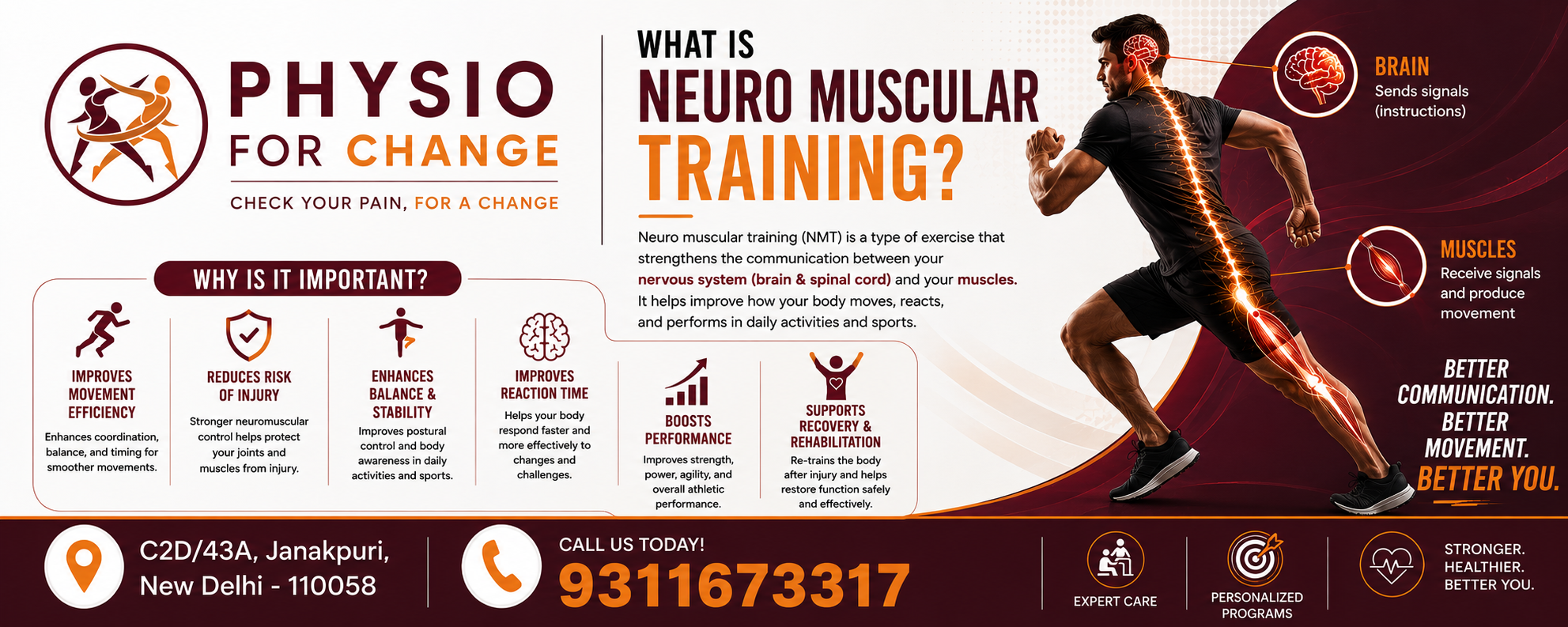
Rewire the Mind, Relieve the Pain: Why Neuromuscular Training is the Future of Rehab
Rewiring Your Movement: What is Neuromuscular Training and Why Your Body Needs It
Have you ever wondered how an elite athlete can change directions in a split second without toppling over? Or how your body instinctively catches itself when you slip on an uneven sidewalk?
It’s not just about muscle strength; it’s about communication.
At Physio For Change, we don’t just focus on making your muscles stronger—we focus on making them smarter. That is exactly what Neuromuscular Training (NMT) is all about.
Let’s dive into what NMT is, why it’s a game-changer for your health, and how it can help you move better, heal deeper, and live pain-free.
What Exactly is Neuromuscular Training?
To understand neuromuscular training, think of your body like a computer network. Your brain is the software, your muscles are the hardware, and your nerves are the cables connecting them.
Neuromuscular training is a specialized form of exercise designed to improve the communication between your brain (neuro) and your muscles (muscular).
Instead of just lifting weights to build bulk, NMT trains your brain to fire the right muscles, at the right time, with the right amount of force. It enhances your proprioception—your body’s subconscious awareness of where it is in space.
Core Elements of NMT:
-
Balance and Stability: Teaching your joints to stay steady during movement.
-
Agility and Coordination: Changing directions quickly and smoothly.
-
Plyometrics: Dynamic, explosive movements (like jumping and landing safely).
-
Strength and Core Control: Aligning your trunk and limbs to distribute impact evenly.
The Science: How NMT Heals From the Brain Down
Your body functions entirely on electrical signals traveling from your brain to your limbs. When you experience an injury, chronic stress, or poor posture, those communication lines get damaged or "static" on the line occurs.
When you participate in neuromuscular training, you aren't just working your joints—you are rewriting your nervous system:
-
Activating Receptors: The specialized exercises trigger sensory receptors in your muscles and joints.
-
Brain-Driven Healing: These receptors send powerful feedback loops back to your brain, essentially telling it exactly where the damage or weakness is.
-
Healing Peripheral Nerves: In response, the brain optimizes its outgoing signals. This neuroplasticity—the brain's ability to reorganize itself—helps repair and heal the peripheral nerves in your limbs, restoring proper sensation and function.
Real-World Impact: Breaking a 7-Year Cycle of Chronic Pain
To understand how powerful this is, let's look at a real example from our clinic.
Imagine a patient who has suffered from severe back pain for seven long years. Traditional, general rehabilitation and standard strength training might offer some temporary relief over a couple of months. However, because the root cause is neurological, the pain often creeps back.
Why? Because after seven years, the brain has literally "memorized" the pain. It expects movement to hurt, so it creates faulty movement patterns to protect itself.
How NMT Changed the Game:
Instead of just strengthening the back muscles, we applied Neuromuscular Training using Bilateral Limbs (working both sides of the body simultaneously in highly coordinated patterns).
The results were profound:
-
Altering the Mind's Pain Blueprint: By engaging both limbs in specific, coordinated vectors, we forced the mind to alter the pain component it had stored for nearly a decade.
-
Accepting New Vectors: The brain stopped viewing movement as a threat. It accepted these new, balanced movement vectors, immediately reducing the protective muscle guarding that causes pain.
-
Significant Changes in Body Movement: The patient didn't just experience a drop in pain—their entire posture, walking pattern, and fluid movement were restored.
Why Neuromuscular Training is So Important
Whether you are recovering from an injury, managing chronic pain, or trying to improve your athletic performance, NMT is the missing puzzle piece for long-term physical health. Here is why:
1. A Proven Solution for Chronic Pain
As shown in our case study, emerging medical studies show that chronic pain can be treated much more effectively through neuromuscular training. By correcting the faulty brain-to-muscle signals that cause chronic tension, NMT targets the root neurological cause of pain rather than just masking the symptoms.
2. It Helps You Perform Better
If you play sports, run, or lift weights, brute strength will only get you so far. NMT improves your reaction time, power output, and movement efficiency. When your brain and muscles are perfectly synced, you waste less energy, hit your targets with precision, and unlock a much higher level of athletic performance.
3. It’s the Ultimate Injury Prevention Tool
Most injuries—like ACL tears or rolled ankles—happen in a fraction of a second when the body is caught off guard. NMT pre-programs your reflexes. It teaches your muscles to automatically stabilize your joints during sudden movements, drastically reducing the risk of a re-injury.
4. It Corrects Bad Movement Habits
Over time, our bodies develop "compensation patterns." For example, your lower back might be doing the work your glutes are supposed to do. NMT hits the reset button, breaking those bad habits and restoring optimal movement mechanics.
What Does an NMT Session Look Like?
If you come see us at Physio For Change, your neuromuscular program won't look like a standard gym workout. Because it requires high mental focus, it is highly tailored and dynamic. Your sessions might include:
| Exercise Type | What it Looks Like | Why We Do It |
| Bilateral Coordinate Drills | Squatting or pressing using both limbs on slightly unstable surfaces. | Forces the brain to balance input across both sides, wiping out asymmetrical compensation patterns. |
| Single-Leg Progressions | Balancing on one leg on a foam pad while catching a ball. | Challenges your ankles, knees, and hips to stabilize under unpredictable stress. |
| Perturbation Training | Gently pushing you while you hold a specific position. | Teaches your core and joints to react and adapt to external forces. |
Experience the Power of Smart Movement
If you are tired of dealing with recurring injuries, feel unstable on your feet, or want to finally find relief from chronic pain that traditional treatments couldn't fix, it’s time to look beyond traditional exercise.
Your journey to better movement starts with resetting the signals between your brain and your body.
Ready to retrain your brain and transform your movement?
Book a personalized assessment with Dr. Mehak Nanda at PHYSIO FOR CHANGE today. Let’s build a stronger, safer, and more resilient you!